Sleeping on the Water: What to Expect from a Chobe Houseboat Safari
From booking accommodations to arranging guided tours, we'll make sure your Botswana adventure exceeds all your expectations. Contact us today to start planning your dream trip!
Please share this article







In the vast lexicon of African safari experiences, the “Game Drive” is the noun and the “Lodge” is the verb. We are conditioned to believe that a safari involves waking up in a thatched chalet, climbing into a dusty 4×4, and driving out to find the animals.
But in the far north of Botswana, where the Chobe River forms a shimmering border with Namibia, there exists an alternative. It is a safari where the road is made of water, where the view changes with every bend of the river, and where the elephants come to you.
Welcome to the world of the Chobe Houseboat Safari.
For many travelers, the idea of staying on a boat in the middle of the African wilderness is a novelty—something to add on for a night or two. But for those in the know, it is the pinnacle of immersion. It offers a level of intimacy, privacy, and perspective that land-based lodges simply cannot match.
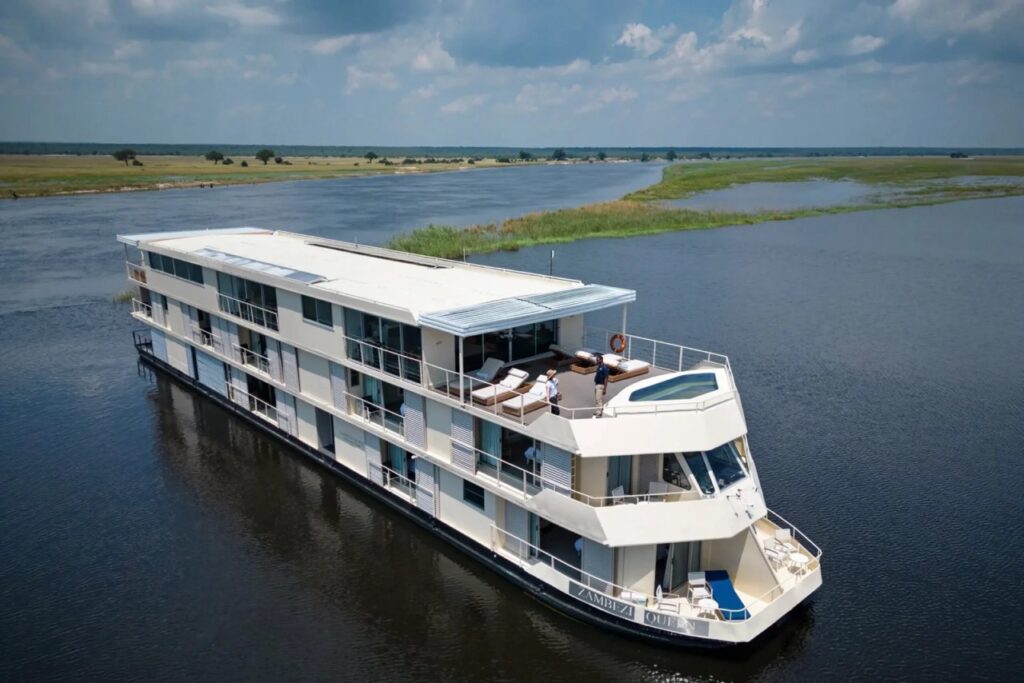
Whether you are considering the boutique luxury of the Chobe Princess or the floating palace that is the Zambezi Queen, this guide will tell you exactly what to expect when you trade the solid ground for the gentle current of the Chobe.
1. The Concept: A Floating Boutique Hotel
The first misconception to clear up is the nature of the “houseboat.” When people hear the term, they often imagine a cramped, self-drive pontoon or a rustic fishing shack on a barge.
In the Chobe region, a houseboat is essentially a luxury floating lodge.
The Vessel Types
- The “Floating Hotel” (e.g., Zambezi Queen): These are large, multi-deck vessels. They function like a boutique cruise ship. They have spacious dining rooms, lounge bars, plunge pools on the top deck, and anywhere from 14 to 30 suites. They are social, vibrant, and offer a resort-style experience on the water.
- The “Private Villa” (e.g., Chobe Princess): These are smaller, more intimate vessels, typically with only 4 or 5 cabins. They can be booked by individual couples, but they are often taken on an “exclusive use” basis by families or small groups of friends. Staying on one feels like staying in a private holiday home that happens to move.
The Cabin Experience Regardless of the boat size, the cabins are designed to maximize the connection to the river. You can expect:
- Floor-to-Ceiling Windows: Most cabins have sliding glass doors that open up the entire wall to the river.
- En-Suite Luxury: Full bathrooms with hot showers (and sometimes bathtubs), air-conditioning (essential in October), and king-sized beds.
- The View: This is the game-changer. You don't look out at a garden or a fence; you look directly at the Chobe National Park. You can lie in bed with your morning coffee and watch a troop of baboons foraging on the bank just 20 meters away.
2. The Location: The Magic of the Namibian Side
Here is a geographical quirk that defines the houseboat experience: Almost all Chobe houseboats are technically in Namibia.
The Chobe River separates Botswana (to the south) from the Zambezi Region of Namibia (to the north).
- The Boarding Process: You arrive at Kasane Immigration in Botswana, stamp out, take a tender boat across the river to Impalila Island (Namibia), stamp in, and then board your houseboat.
- The Advantage: Because the boats moor on the Namibian side or in the middle of the channel, you are looking at Botswana. You have the best view of the famous Chobe National Park riverfront, but you are physically separated from the busy game drive routes and the town of Kasane.
- The Silence: Once the day-trip boats from the Botswana lodges return to their jetties at sunset (usually by 6:00 PM), the river belongs to you. The silence that descends on the water is profound, broken only by the sounds of the bush.
3. The Daily Rhythm: A Slow Safari
Life on board follows the rhythm of the sun and the river. It is significantly more relaxed than the 5:00 AM wake-up calls of a land-based safari.
06:00 AM – The Sunrise Wake-Up There is no need for an alarm clock. The sun rising over the river, turning the water a burnished gold, will wake you. You might hear the distinctive “grunt-honk” of a hippo surfacing near the boat or the cry of an African Fish Eagle. Coffee is usually available in the lounge or brought to your cabin.
07:30 AM – Breakfast with a View Breakfast is a leisurely affair served on the open-air deck. As you eat your eggs and bacon, the captain might navigate the big boat slowly upstream. You watch the landscape slide by—a cinema screen of wilderness. You might see elephants coming down for their morning drink or crocodiles basking on the sandbanks to warm up.
09:00 AM – The Morning Activity You board the smaller “tender boats” (motorized skiffs). These shallow-draft boats can navigate the tight channels and get right up to the grassy banks.
- The Focus: This is prime time for birding. The light is good, and the birds are active. You might head to a specific bank to see a colony of Carmine Bee-eaters nesting in the sand cliffs.
13:00 PM – Lunch and The Heat of the Day You return to the mother ship for a buffet lunch. By now, the African heat is building.
- The Siesta: Unlike a lodge where you are stuck in your room or a fenced garden, on a houseboat, the midday heat is the best time for game viewing. Why? Because the elephants get hot too.
- The “Armchair Safari”: You can sit in the plunge pool or lounge on a sofa with a cold drink while the boat is moored opposite a popular elephant crossing point. You watch entire herds—matriarchs, babies, and teenagers—splash, swim, and mud-bathe. You don't have to go find them; they come to the water.
16:00 PM – The Sundowner Sortie You head out on the tender boats again. This is “Golden Hour.” The light turns soft and honey-colored. The water turns glassy.
- The Goal: Photography and atmosphere. You might find a pod of hippos yawning (a threat display, but great for photos) or watch a huge herd of buffalo kicking up dust on the floodplains.
- The Drink: The guide cuts the engine in the middle of a lagoon. He opens the cooler box. You sip a Gin & Tonic while the sun turns into a giant red orb and sinks behind the teak trees.
19:30 PM – Dinner Under the Stars Dinner is usually a three-course meal served on the deck. Because there is zero light pollution on the river, the stars are incredibly bright. The sounds of the night—lions roaring in the distance, frogs chirping—provide the soundtrack.
4. The Wildlife: What Will You Actually See?
A common question is: “Will I see as much as I would on a game drive?” The answer is: You will see different things, and you will see them differently.
The Elephant Interaction Chobe is the elephant capital of the world. Seeing them from the water is superior to seeing them from land for two reasons:
- Eye Level: On land, you are looking down at an elephant from a high vehicle. On a boat, you are low down. Looking UP at a drinking elephant emphasizes their size and majesty.
- Behavior: Elephants love water. They are playful, relaxed, and social when swimming. You get to see a joyous side of their personality that isn't always evident when they are browsing in the forest.
The “Big Stuff”
- Guaranteed: Elephants, Hippos, Crocodiles, Buffalo, Water Monitor Lizards.
- Frequent: Giraffe, Kudu, Impala, Baboons, Waterbuck (Puku and Lechwe).
- Possible: Lions and Leopards. Cats often come down to the river to drink or hunt. Seeing a lion from a boat is a rare thrill.
- Unlikely: Cheetah and Rhino (they tend to stay inland).
The Birding For birders, a houseboat is paradise. The Chobe River ecosystem supports over 450 bird species.
- Waterbirds: African Jacanas, Herons, Egrets, Kingfishers (Pied, Malachite, Giant, Woodland), and the majestic African Fish Eagle are seen daily.
- Specialties: In the summer, you can see African Skimmers (nesting on sandbanks) and Rock Pratincoles.
5. Unique Activities: Beyond the Binoculars
Houseboats offer activities that land lodges can't facilitating.
Tiger Fishing The Chobe and Zambezi rivers are home to the Tigerfish, Africa's most ferocious freshwater game fish.
- Most houseboats offer guided fishing excursions. They provide the tackle (rods, reels, lures).
- It is strictly Catch and Release.
- Even if you aren't a serious angler, trying to hook a Tigerfish while sipping a beer is a fun afternoon activity. Bream (Tilapia) fishing is also popular and slightly more relaxing.
Photographic Safaris Some houseboats (like the Zambezi Queen fleet) have specialized photographic tender boats.
- The Setup: These boats have custom swivel chairs with gimbal heads to mount your camera. This provides incredible stability for long-lens photography.
- The Angle: Being able to rotate 360 degrees and get low to the water allows for award-winning composition—like the reflection of an elephant in the still water.
Village Walks Because you are on the Namibian side, you have access to local villages that are far removed from the tourist hubs of Kasane.
- You can take a tender boat to a local village on the floodplains.
- This is a cultural interaction—seeing how people live in an environment dominated by seasonal floods and dangerous wildlife. You might see the local school or learn about how they protect their crops from elephants.
6. The Seasons: When to Book a Houseboat
The experience changes drastically depending on the water levels and the rainfall.
The Dry Season (May to October)
- The Landscape: The interior of Botswana dries up. The Chobe River becomes the only water source for thousands of square kilometers.
- The Wildlife: This is Peak Season for game viewing. The banks are crowded with elephants and buffalo. The predator action is high.
- The Weather: Sunny, cloudless days. Cold mornings, warm afternoons.
- The Verdict: The best time for massive herds and Big Five sightings.
The Green Season (November to March)
- The Landscape: It rains. The bush turns green. The interior pans fill with water, so the animals disperse away from the river.
- The Wildlife: You will see fewer elephants (though still plenty of resident bulls). However, this is the birthing season for antelope (impala lambs everywhere) and the absolute best time for birding.
- The Fishing: Fishing is generally better in the warmer months.
- The Verdict: The best time for birders, photographers (dramatic skies), and people who want quiet and lower rates.
7. Motion Sickness and Bugs: Addressing the Fears
Two common concerns prevent people from booking houseboats. Let’s address them.
“Will I get seasick?”
- No. The Chobe River is not the ocean. It is a slow-moving, flat expanse of water. There are no waves.
- The large houseboats (Zambezi Queen) are incredibly stable. You barely feel them move.
- The smaller boats (Chobe Princess) might rock very gently if a speed boat passes by, but it is a soothing motion, not a nauseating one. If you can handle a car ride, you can handle this.
“Are there mosquitoes?”
- Yes. You are on water in Africa. There are mosquitoes.
- The Mitigation: However, houseboats are often less buggy than land lodges. Why? Because they are moored in the middle of the river where there is often a slight breeze that keeps insects away.
- Protection: All cabins have mosquito nets or screened windows/doors. The boats are sprayed down in the evenings. If you wear repellent and keep your screen door closed, it is rarely an issue.
8. Packing for a Houseboat
Your packing list is similar to a land safari (neutral colors, sun protection), with a few tweaks:
- Non-Slip Shoes: Boat decks can get wet. Wear shoes with good grip.
- Motion Sickness Meds: Just in case (psychological comfort).
- Polarized Sunglasses: Essential. The glare off the water can be strong. Polarized lenses allow you to see into the water to spot hippos and fish.
- A Good Book: There is more “downtime” on a boat than a busy lodge. It is the perfect place to read.
9. Conclusion: The Ultimate Unwind
A Chobe Houseboat safari is the antidote to the “rushed” safari. It forces you to slow down. You can't rush to the next sighting because you are floating toward it at 5 knots.
It is a sensory experience—the smell of the water, the sound of the hippos, the cooling breeze on the deck. It offers a perspective of the wilderness that is intimate and exclusive.
For many, the highlight of their Botswana trip isn't the leopard they saw on a game drive; it's the moment they sat on the bow of a boat, gin and tonic in hand, watching a herd of elephants swim across the sunset, realizing that for tonight, the river is their home.
Ready to come aboard? At Travel 2 Botswana, we work with the finest vessels on the river, from the family-friendly to the ultra-luxurious. Contact us today to check availability for your floating safari.
 ASK A QUESTION